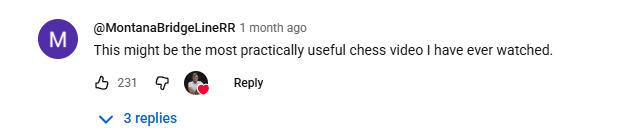
This is the story of how I nearly deleted the footage of a video that now has 77K views. A video that has several comments saying something along the lines of:
“This might be the most practically useful chess video I have ever watched.”
Why did I nearly delete it?
Because I thought it wasn’t good enough.
When The Overthinking Happens
The video the comment is referring to is titled “Inside a Grandmaster’s Thought Process (Blitz, Rapid, Classical)”.
I recorded it with the mindset of helping the one student in SCIS that shared this position. That was a success. But after Alessia did the cuts, and especially once the first video blew up, the overthinking started.
“That’s way too long for one single position”
“The lighting is really bad”
“This is too niche”
“It will be too deep for many that are watching”
The time between recording the video and publishing was roughly 2 weeks. That’s plenty of time for my mind to play many tricks on me. At some point I was convinced I won’t upload this video.
Then, I thought I might just share it with my course students but not on YouTube.
What saved me was that I didn’t have another video to publish and felt I should publish soon after the big success of the first video… Lucky me!
Now I have many comments saying I should make this a series, focusing on one single position and explaining it in depth. What in my mind wasn’t useful enough is now what many call the most useful chess video on YouTube.
We Are Bad At Assessing Our Own Work
This overthinking has many different facets. Steven Pressfield calls it “resistance” in his amazing book ‘The War of Art’.
The key takeaway is: focus on the process. Put out your work. Let others decide which piece of advice is super useful and which one is ‘meh’. The only thing you can do is doing your best in the moment.
For me that means going back to the mindset of recording a video to help one person. Trying my best while I prepare and record. Then click publish and let the world decide.
What does it mean for you in chess improvement?
Overthinking In Chess
As so often, there is a lesson hidden that you can apply to your own chess improvement.
Here is what I see extremely often in adult improvers (especially the smart ones).
Adult improvers try to first understand what will definitely be the most useful thing to do before doing. The problem is that often they will never start really doing.
The uncomfortable truth is this:
Both you and me will never have the guarantee that something we do will pay off. There is no such guarantee in life.
- The person you love right now can betray you in the future
- The house you buy can be destroyed in a tornado
- The business you worked so hard to build can go bankrupt because a pandemic hits
This is uncomfortable. But it can also be freeing. As there is no guarantee, we can move quicker and try more things. Instead of putting all of our effort into figuring out the “best way”, we can put much more energy into executing a “good enough” way and adapt to future circumstances.
The only thing we can do is take an educated guess, follow what worked for many others, try our best and see what happens.
Concrete Application
Start with a simple plan. While training your chess don’t try to assess how useful this is. Just do your best executing what you planned. Once a week, review your plan. Think about 1 thing you can improve next week. Change it and then get back to executing.
The key is to stick to something long enough to see if it paid off. YouTube has a pretty quick way of giving feedback, in chess you need to wait much longer. In this period, instead of thinking “What else could I train?” ask yourself “How can I execute what I train even better?”.
That means, instead of jumping around, improve your focus, the way you solve tactics and how you analyze games.
And most importantly, instead of asking “Can I reach 2200 rating if I put in 2 hours a day” just start putting in the two hours per day. Then see where it leads you in a few years.
I can guarantee you 100% no matter how much time you spend to understand what effects your training will have, you will always be surprised.
What Feels Bad is Often Useful
Here is one more thing that specifically applies to improving a skill.
The training that feels hardest, when you feel stupid, like your brain breaks, is often the most useful.
If you start judging yourself and the training based on how you felt, you will only do things you feel comfortable with… and thus drastically limit your improvement.
Want to improve your chess?
Just do it. See what happens. Maybe you’ll be as surprised as I was when I saw the comments on this video.
Keep improving,
GM Noël Studer
PS: I’m trying to publish more often and sometimes a little bit less polished content on YouTube. It helps a ton if you leave a comment which type of video you like most, so I can do more of these.
PPS: This article was initially sent out to my Newsletter list. If you want to get chess improvement advice for free in your inbox, join 17,000+ chess improvers by signing up for Friday Grandmaster Insights here.
Whenever you’re ready, here is how I can help you:
- Want to know How to train chess well? Check out The Simplified Chess Improvement System. This course taught 800+ students the How of Chess Training. Create your high-quality chess plan and learn how to study each part of Chess, from tactics to openings & endgames. Click here to learn more.
- Rated below 1200 Chess.com? Need to refresh your fundamentals? Check out my course, Beginner Chess Mastery. You’ll learn all the fundamentals, from strategy to how to get the most out of your pieces, tactics, and endgames. You even get a full opening repertoire for free. Click here to learn more.