Last week I shared how results-oriented goals (I Failed all of My Goals in 2025 – But it was a great Year) have a motivating side, but often turn out to be toxic for me. The thing is, I can reach all my results-oriented goals, but hate the process of getting there. Or, I can fail all of my results-oriented goals, just like in 2025, and still have a great year.
What is the point then?
So since then, I’ve been reflecting on what actions I would like to do more and less of. Any potential goal should inspire these actions consistently. In this deep dive article, I’ll get into my single goal for 2026, why I think it matters and how I chose it.
I hope that by reading it, you’ll get inspired to find a better goal for yourself, too. And if it inspires only one reader to take better care of their health and reduce stress, the longwinded article was worth it 🙂.
So drumm roll please, this is the single goal for 2026 I came up with:
Double my average HRV in 2026.
What Even is HRV?
For the non-health nerds, HRV stands for Heart-Rate-Variability. Here is what Harvard Health Publishing has to say about it:
HRV is simply a measure of the variation in time between each heartbeat. This variation is controlled by a primitive part of the nervous system called the autonomic nervous system (ANS)… Based on data gathered from many people, if the system is in more of a fight-or-flight mode, the variation between subsequent heartbeats tends to be lower. If the system is in more relaxed state, the variation between beats may be higher.
I’ve been tracking my HRV through the Oura Ring for the past 5 years, so I have a pretty good understanding of my baseline, and how my HRV corresponds to stress, fatigue, bad habits and my Traumatic-Brain-Injury. I also talked with doctors and my therapists about my HRV, so I feel well informed to pick such a goal – and make sure it is not backfiring.
This is not medical advice!
So please, don’t just copy my goal or take some health goal you aren’t sure is actually healthy for you. HRV – and other health metrics, are extremely personal, gender- and age-dependent. What could work for me might not be good for you. This is meant as inspiration, for you to find something as important as HRV is for me, and set that as a goal.
As of writing this, my average HRV is 38ms. The goal for 2026 thus is having an average HRV of 76 on December 31st 2026 (the average determined by Oura is based on a couple of weeks, but I’ll have to build up good habits to get that increase in December).
Here is the short version of why I think this goal is different:
- It forces me to pick up healthy habits
- It is easily measurable
- Achieving it means better health
- It will have a positive impact on everything I try to do & achieve
How To Improve one’s HRV
Based on my current understanding, a better HRV for the most part means a better ability of one’s body to adjust to different modes. With my low HRV, it can sometimes take me more than 12 hours to fully recover from a hard gym session or a long run. That means, I can do sport in the morning, and will still have an elevated Heart Rate by the time I want to go to bed.
Once I enter fight or flight (difficult exercise is a positive way to do that, but nevertheless fight or flight), it is very hard for me to go out of it. I experience the same with winding down from work. I have a very hard time to switch from Business thinking to relaxed free time. Alessia, with a very high HRV, can switch her modes basically instantly, which feels to me like a superpower.
The more I learn about HRV, the more it feels like nearly all healthy habits I want to make stick (but often fail to) will have a positive impact on my HRV.
- Reduce Stress
- Take Breaks
- Healthy Nutrition
- Hydration
- Sun exposure in the morning
- Regular exercise
- Meditation
- Breathing Techniques
- Cold Exposure
The list goes on.
I assume I don’t have to nail everything on this list to double my HRV, but doubling my HRV would definitely mean I improved many of the things above, which would be a huge win. Not fully reaching the goal but increasing it by 50% would already make a real difference, which is also very nice. One fact I particularly like is that doing too much of anything can again have a negative impact on HRV. Exercise is good, but if you exercise every single day, your HRV actually goes down.
The month I trained too hard for my Half-Marathon was also the month with my lowest HRV in 2025.
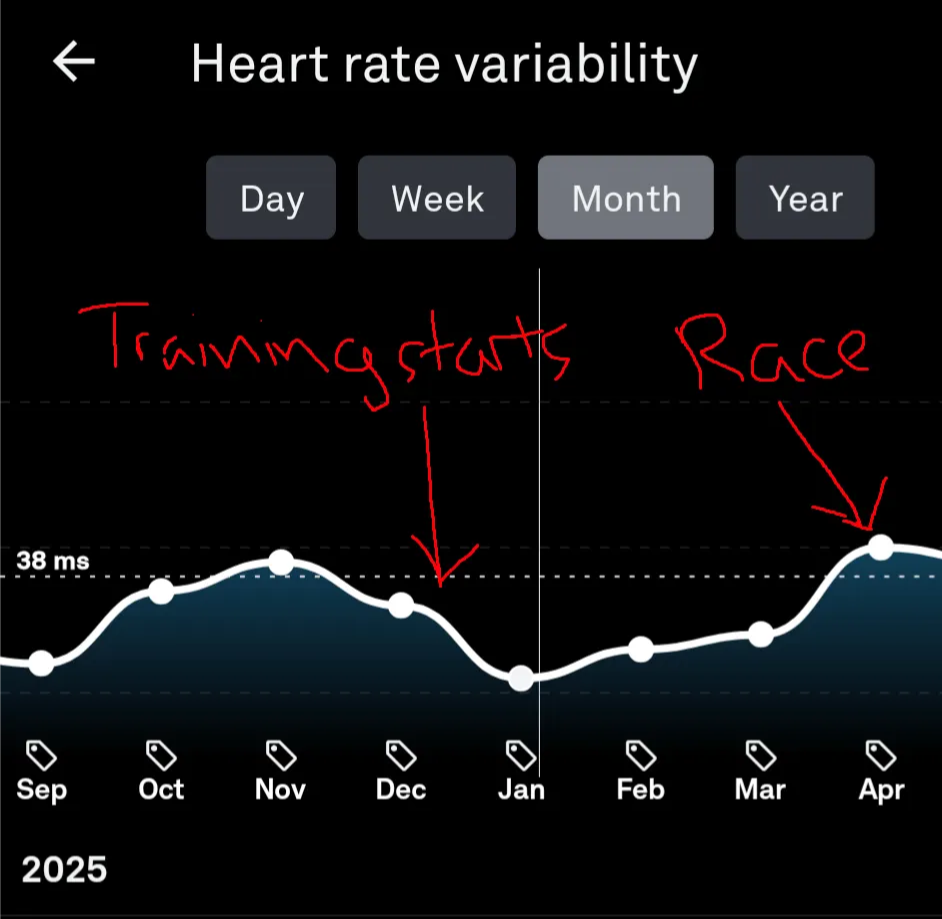
And HRV is an average, thus a long-term project. It won’t change drastically if I take all of the things above and do them well for 1 day or even a week. Even if I did pick up everything quickly, I’d still need to keep all these habits until the end of december. So I’ll better take it slow and build them up over time.
Measure What Matters
A big reason why a lot of us come back to rating points, money and trophies as measurments of success is that these things are so easily trackable. In the absence of a clear other goal, we drift towards easily accessible things we all have and can rank ourselves in.
This is way easier than say, how happy you feel, or how much freedom you have. Because with those things one can instantly think:
“What does happiness even mean? Freedom in what sense? Is Freedom always good?”
Also, it is not as direct to see what actually has an impact on happiness, at least much less direct than if something makes money or which game increased your rating. Just as the book Measure What Matters says, whatever we set our eyes out to do and track, we will have a better chance to achieve.
The problem is: nearly nothing that is easily measurable truly matters. That’s why I’m very happy that the HRV is easily measurable for me (I wear the Oura Ring every day, just need to charge it every 5 days or so).
It is what sets it apart from more vague goals like:
- Reduce stress
- Increase happiness
Much harder to put a number on these things. But by increasing my HRV, I hope I automatically achieve the above mentioned things.
Higher HRV = Better Health = Better Work
And even if I just cared about my business output, I feel this would be a smart long-term goal. The healthier I feel, better I can recover, more clarity I have, the better my work will be. Pushing through a short period of intense work and stress can help with the business. But over a long period of time, I need to avoid burnout, be mindful of my energy and make sure I enjoy what I do.
Most of us have jobs where a few things we do have an incredible impact on our overall work performance. So just forcing myself through a 40-hour workweek with mediocre focus, maybe even pushing to do weekends, isn’t smart, even if that was the only thing I cared about.
It is the same in chess improvement.
Even if all you care about is your rating going up, training too hard and not smart isn’t going to get you there, at least not in the long run. And I’m pretty sure if you’ve read until here you understand other things matter way more than your rating moving up.
I’ve Got The Goal – Now What?
So, it is January 16th and I have my goal for the year. Now what?
Most of us set goals, especially when the new year arrives. Very often, they are abandoned already in the first weeks of the year.
To avoid being part of this group, I want to take it step-by-step. Instead of rushing to change all my habits at once, I have a rough idea of which habits I tackle first, and which ones will be the focus point later in the year.
Here is what I’m trying to apply in January (note that I’ve started implementing some of those in December, without a clear goal in mind):
- 1x Gym per week —> I often tried 2-3x, but then didn’t stick to it. 1x is super manageable and I want to be able to do it for all the remaining weeks of the year.
- Working with a timer —> I simply use my PCs timer function to time 25-55min slots of work, then take a 5-15 minute break.
- Cold shower —> Ideally every morning, time doesn’t matter, even 5 seconds wakes me up.
There really is no excuse to not do these habits, as they are super small and easily applicable. And for those thinking:
You’ll never reach your goals with such tiny changes
here are my HRV stats for the start of the year. I just started being a little more mindful about some habits, without setting a clear goal.
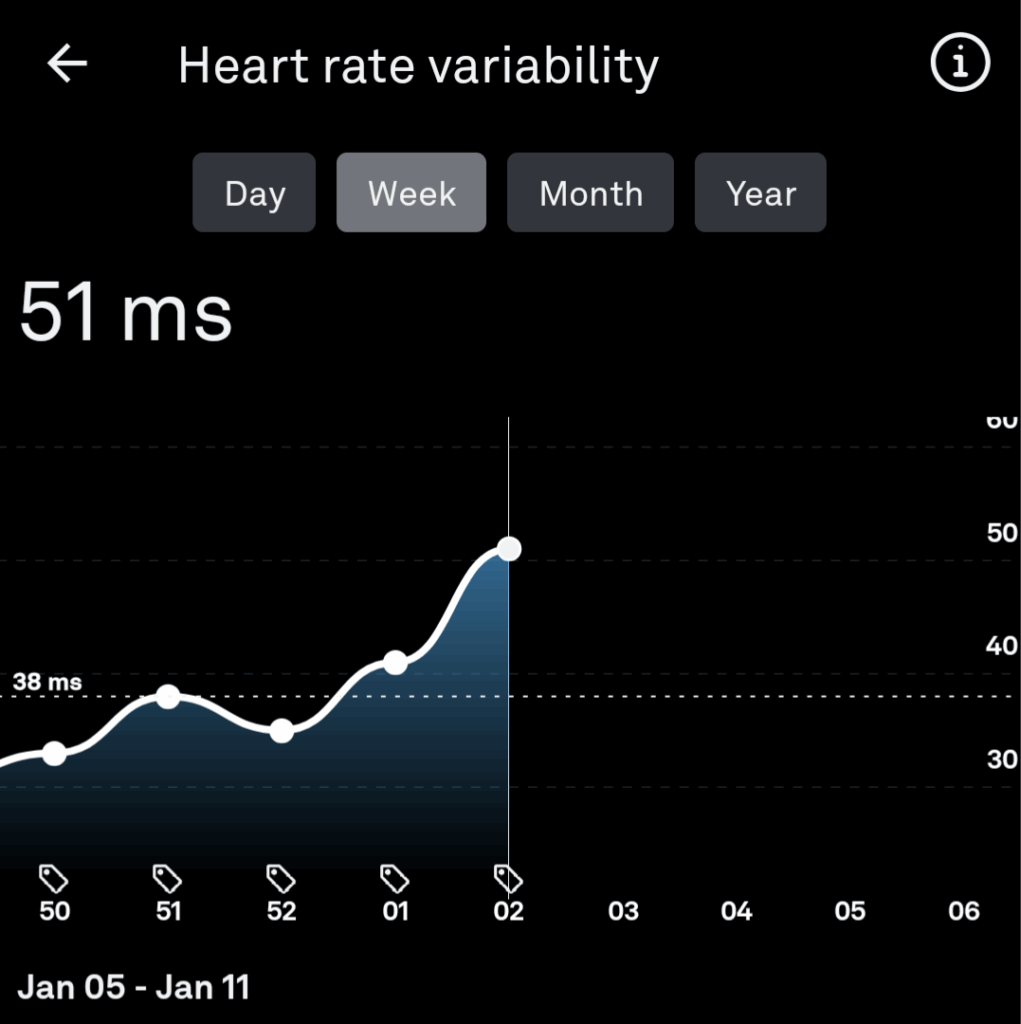
That’s a whopping 34% increase versus my baseline. And I have so much potential left. I’m really excited about this year, with even less results focus.
It is all about habits, systems & the process. I’ll share how this is going for me.
What about you? Which habits would you like to finally make stick? Let me know by replying to this email. I can’t answer everyone, but I do read all my emails.
PS: I have no affiliation with the Oura Ring. Just a happy customer. One of the few brands I’d be happy working with, though 🙂.
Keep improving,
GM Noël
PPS: This article was initially sent out to my Newsletter list. If you want to get chess improvement advice for free in your inbox, join 17,000+ chess improvers by signing up for Friday Grandmaster Insights here.
Whenever you’re ready, here is how I can help you:
- Want to know How to train chess well? Check out The Simplified Chess Improvement System. This course taught 800+ students the How of Chess Training. Create your high-quality chess plan and learn how to study each part of Chess, from tactics to openings & endgames. Click here to learn more.
- Rated below 1200 Chess.com? Need to refresh your fundamentals? Check out my course, Beginner Chess Mastery. You’ll learn all the fundamentals, from strategy to how to get the most out of your pieces, tactics, and endgames. You even get a full opening repertoire for free. Click here to learn more.