Hey everyone,
I hope those of you celebrating had a lovely Thanksgiving. Before we get into today’s newsletter, a quick announcement:
Both my Courses are 25% off until Tuesday 3 PM CET. As always, you have a 14-day money back guarantee, so you can get them now at a reduced price without any risk.
Simplified Chess Improvement System
Calculating a line from start to finish is one of the hardest things in chess. At least for most people.
Then, you see some of the younger top GMs and it seems like second nature to them. What are they doing differently?
Aside from tons of practice and a good bit of natural talent, I’ve observed the same habit with top calculators around the world. They don’t stop when it gets hard. But first, let’s look at how a lot of chess improvers calculate.
Monkey Brain Calculation
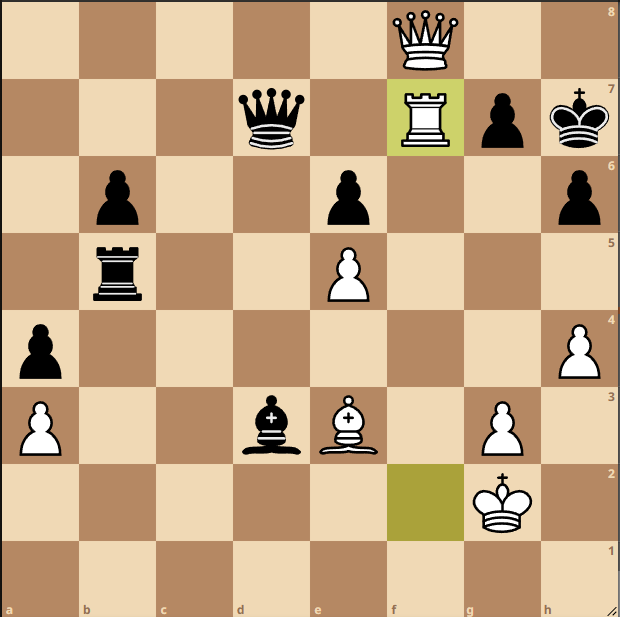
Most of us look at a difficult position (like the one above) and our brain starts going immediately. Maybe Qd5+, hmm but maybe Rb2+ is better. What about Be4+? Ok let’s calculate a bit, Qd5+ Kh2 Rb2+ Bf2, ah that doesn’t work, let’s look at Rb2+ Bf2, wait, what am I supposed to do tonight after playing chess? Shoot I still have to buy flowers for my partner. Ok back to the chess, what was I thinking again?
At this point you might abort mission and simply trust your intuition and play something. Not great.
If you feel spoken to, let me tell you this isn’t because you are stupid or bad at chess. Your brain simply isn’t trained to calculate properly. Especially now that I haven’t trained my own calculation for 4.5 years, my brain does this often as well.
With the right techniques, this will get better.
Our Brain Is Lazy
But first, a frequent reminder. This won’t be easy.
Let’s face it. Our brain is naturally lazy. So whenever we hit a roadblock, we search for something easier. In chess terms, that means instead of going deeper into a line and figuring out if it works or not, we simply change the line and see if there is a line that is easy to calculate.
In real life the same habit happens ever so often. When I’m writing and unsure of my next sentence or paragraph, I often feel tempted to check my phone, check some analytics; e.g. do something easier. That is my brain trying to escape a difficult task. Good work happens when I’m able to push through this moment and keep focusing on the task at hand.
In a digital world with always more sophisticated distractions, this gets increasingly hard.
But as Ryan Holiday put it beautifully:
“The obstacle is the way” – Bestselling book by Ryan Holiday
How Top Coaches Teach This
If you want to calculate like a Grandmaster there are two Coaches that stand out. Their approaches are pretty similar. I’m talking of GM Jacob Aagaard and GM Ramesh RB. I was lucky enough to take part in a training camp with both of them when I was still an active player. And even as a Grandmaster, their methods were extremely difficult – but equally useful for me.
They didn’t have long speeches or sophisticated thought processes. They simply forced us to work through positions and push through this moment of resistance. One session I vividly remember is when we saw a position on a projector, then needed to keep this position in our minds without seeing it anymore and we discussed it for 45-60 minutes. It felt as if my brain was breaking. Every few minutes I had the temptation of just giving up (resistance). But Ramesh kept pushing us, discussing more lines until we as a group found the correct continuation.
When training in such a group setting, it got increasingly clear who was able to push through these moments (mostly the kids that got trained by Ramesh or Jacob) and who had more difficulty (mostly western european lazy GMs; e.g. me 🙂). A big part of the success of Indian chess in the past decade can be attributed to their ability to calculate and their readiness to push through moments of resistance.
The Solution For Amateur Players
Now before you pick up Calculation by Aagaard and feel like a total idiot because you can’t solve one single position, let me explain how you can use this same idea on amateur level. Calculation is a difficult and complex topic that can’t be explained in a single article.
But there is one technique that stands out and can help you transform the way you think in chess. As always, it is super simple (but not easy at all):
Calculate a line until the end
Yup, that’s it. When you face a position, instead of hopping around, get the habit of calculating a line until the end. Only when you finished calculating this one line, evaluated it and checked if it is safe, move on to the next one (or if it wins, just play it!).
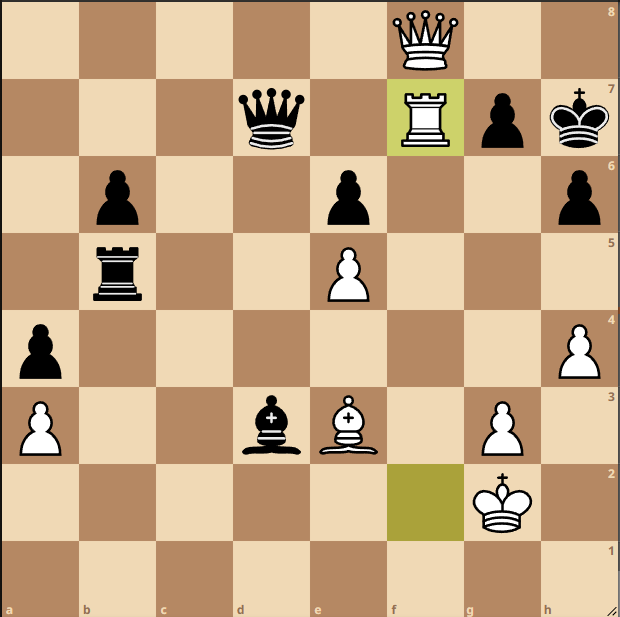
In the position above, instead of mixing your thinking between Qd5+, Qc6+, Be4+ and Rb2+, all forced moves that should be looked at, pick one, calculate it until there are no checks or a resolution of the position, then move on.
You will be surprised that the solution is rather simple. After 1…Qd5+ 2.Kh2 (other moves lose quicker), black can simply take e5 and protect the g7 pawn. There is really not much more to see. But if you keep jumping between moves, you will get lost in the forest and play something that might lose instantly, just like my opponent did. If you want to see the full lines, make sure to check out the YouTube video I did on that position and the topic of calculating a line until the end.
Summary
Calculating correctly is just training your brain to follow a concrete line until the end without jumping around. It is really similar to the art of meditation. Your monkey brain will always tend to jump around and all you have to do is remind yourself to get back to the forced line (focusing on your breath mostly in meditation) and stick to it. And just like meditation, it sounds so easy, but it requires a ton of training to get better at it. Most people aren’t ready to put in the work. If you are ready and you do it correctly, you’ll make huge improvements while others stay stuck.
Keep improving,
GM Noël
Don’t miss out and check out my courses at a 25% discount, only until Tuesday, 2nd of December.
Simplified Chess Improvement System
PS: This article was initially sent out to my Newsletter list. If you want to get chess improvement advice for free in your inbox, join 17,000+ chess improvers by signing up for Friday Grandmaster Insights here.