On March 6th I launched Real Chess Training. 300+ students joined in the first week. The feedback has been incredible. Today I want to share 6 lessons from 6 weeks of Real Chess Training.
Lesson 1: Hard Training Can Be Fun
With all the “quick and easy” messaging out there, doing something hard becomes less attractive. But not only does it work, with the right approach and mindset, doing hard things can be fun.

The main difference is how we perceive difficulty and mistakes. If you see those as a weakness, character flaw or failure, doing hard things will be annoying, even feel dangerous.
When you change into a growth mindset, you can see them as an opportunity to learn. This applies to doing your weekly Real Chess Training, but also every single game.
Instead of: “I need to perform well, otherwise it is a disgrace.”
Think: “This difficult test will strengthen my understanding, skills and decision making.”
Lesson 2: Progress, not perfection
Sticking to a growth mindset, what real improvement looks like is progress, not perfection. It is not like students who joined in week 1 started with 1/6 correct solutions and now crush every test perfectly.
Maybe they even still get the same amount of mistakes. What changed is the quality of mistakes. They start applying the correct thought process, catch themselves when they get lazy and might just get little details wrong.
With a fixed mindset, that’s still “failure”. With a growth mindset, that’s something to be very happy with. Just like this RCT student shared in a comment below one of the solution videos:
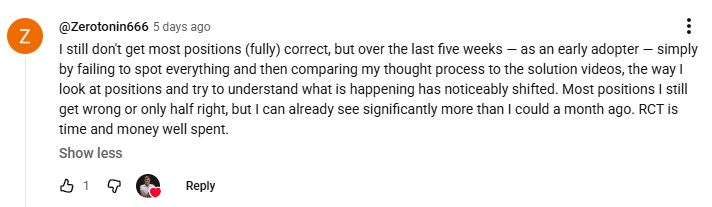
This was my main point in last weeks Newsletter. Just because the outcome might still be unsatisfactory, it does not mean you do not progress or that you failed.
We will always make mistakes, especially in a training that is designed to be hard and push you to the limits. What matters is realizing that applying a better process will get you closer to fully correct solutions, which means better decisions in real games.
Lesson 3: Opponent’s Resources Are Hard To See
There’s one test RCT members struggled with more than any other. I expected it. The test was designed to have positions with tempting moves for yourself, but hidden opponent resources that one should see.
The comment section was full of the same type of message.
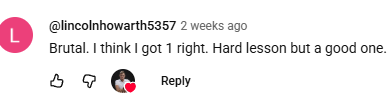
Why is it so hard for us to spot opponent’s resources?
Because we never train to do it. Every time you have a puzzle, you know there is a solution for YOU. Every time you play a game, you look at the board from your own perspective.
Checking for opponent’s resources is a skill you can train. By solving tests like these. And by consistently looking at opponent’s ideas BEFORE you check for anything from your side.
Even when you know there is a tactic. Because no matter what habit you have when training, to check, or not to check, it will go into your gameplay. And having the right habit will save you so many points.

Lesson 4: The right solution doesn’t mean everything went well
The temptation is big. You solve a test, check if you got it right, get 6/6 and feel like a boss. While that is a nice ego-boost, just looking at the results doesn’t give the full picture.
What I care about in Real Chess Training is more than writing down the correct move. It is if you have applied the right process, seen what needed to be seen, evaluated correctly and then made the correct practical decision.
That’s why in my solution videos, I often first show moves that are not considered best, show why and how you can then get to the even better moves.
When you apply the right process, you can transfer that skill from a test to your real games. But when you get the right solution for the wrong reasons, it is very likely the next time you won’t be that lucky. That’s why I was super happy when I saw this comment under one of the tests:
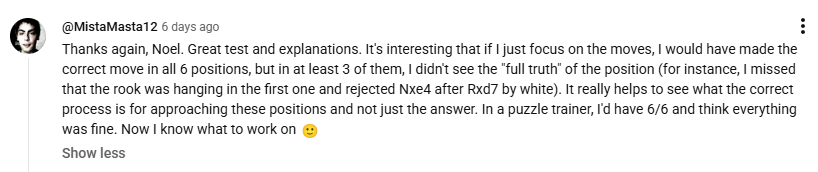
Lesson 5: Your thought Process matters more than the answer
Because this is so important, I’ll expand on the same idea from a different perspective.
Sometimes, I prefer if you get the position “wrong” but apply a smart thought process. Here is how that can look: Imagine a position where there’s a threat you need to deal with, and a tempting sacrifice that catches your eye.
Right solution, wrong process: You don’t spot the threat. You don’t even see the sacrifice. You just play a move, and somehow it happens to be correct. This is dangerous. You got lucky. You missed two key elements of the position.
Wrong solution, right process: You spot the threat. You see the sacrifice. You calculate it deeply but miss one defensive resource and go for it. Wrong answer, but you did everything right except for one calculation detail. You’re much closer to real improvement.
The calculation error is a skill that gets better by doing these tests and tactics. The blindness to threats and candidate moves? That’s a much bigger problem, which can also be tackled, but will take more time.
Lesson 6: Time Management is a skill you can improve
One of the key features of Real Chess Training is the limited 45 minutes members have for a 6-position test. This forces them to train a skill that gets neglected often: time management.
Even if position 1 is extremely complex, and yes, I do that on purpose, you can’t just burn 20+ minutes on one position if you don’t know what’s coming next. That’s the same as in a real game.
On move 15 you have no idea what types of positions and problems you’ll face later. So you need to make practical decisions. When giving yourself ample time in tactics, you are not confronted with this reality.
So the point of Real Chess Training is that you feel you have too little time for all these positions. That’s what forces you to decide, just like in a game: have I seen enough to make a practical decision? Or do I need to continue calculating? Just like in life, we always have less time than what we’d like. Understanding when to invest time and when to save it is one of the key skills you need to learn.
Real Chess Training Is Open Again
Real Chess Training is open again. If you want one hard test every Monday that challenges you, with a solution video that goes deep into the process, join now.
RCT is designed for players rated 1500–2000 (chess.com/FIDE). If you’re below that range, stick with basic tactics for now, it will help you more.
If you’re outside the rating range but love this way of training, let me know by replying to this email. I might launch the same for different rating ranges in the future.
Want to try it first?
This is the first test I sent out and you can now access it for free to see for yourself if this is a good fit.
Just click this link, insert your email and you’ll be sent a free sample. No credit card required.
Keep improving,
GM Noël Studer