Calculation is hard. But many of my students make it harder than it has to be. The truth is: you’ll never see everything. It also isn’t necessary.
You just need to see what is crucial to make a good decision. Here is how.
When It Is Enough
I recently had this position in a 1:1 training with a student. I asked him: “Why does 1…Nf6 not work?”.
Try to answer it for yourself.
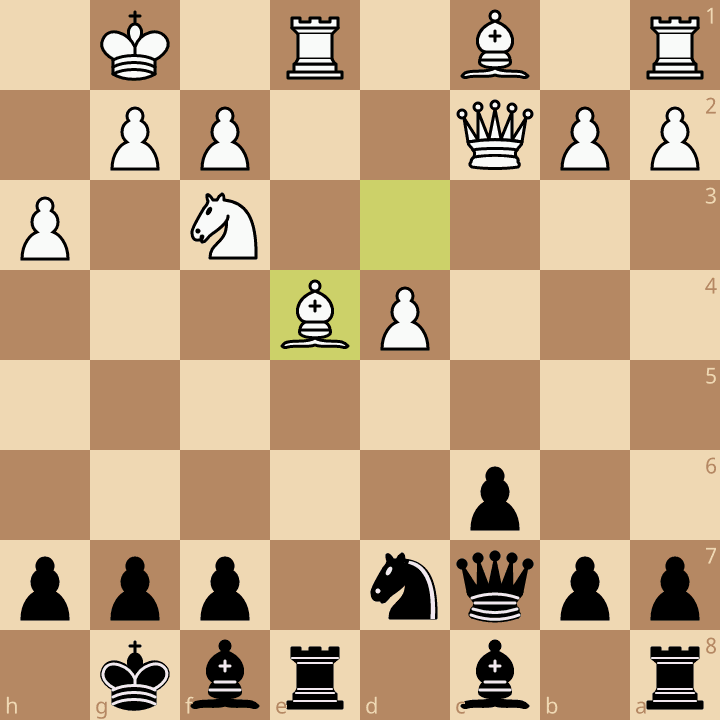
The correct answer is very concrete: White wins a pawn with 2.Bxh7+!, because Nxh7 fails to 3.Rxe8.
My student saw this in seconds. But then something interesting happened. He spotted 2…Kh8 for black. And after 2 minutes of thinking, he said “I don’t know”.
He couldn’t see a way to win even more material after 1…Kh8. The key is: he doesn’t. If 1…Nf6 loses a pawn to 2.Bxh7+, we do not need to see further. We can eliminate that move (unless everything else at least also loses a pawn) and look for better alternatives.
Why This Happens
Even if this example above seemed easy, I’m sure you have fallen for the same trap at some point. Often it happens because we dive deep into a line without clear guidelines. We don’t see the forest for the trees.
It happens in many different positions. Another example is when you are much worse. Every line you calculate, you might conclude “I don’t like this”. And so you burn your clock without finding anything good.
That’s an impossible problem to solve. If you are much worse, you will not like any of the positions. What you need to do instead is to find the position that you like most among the bad ones.
Three Questions That Can Help
Here are three questions that can drive you towards better decision making and less brute force calculation in situations when it isn’t needed.
- Does my opponent have an easy way I dislike? —> Aimed to quickly discard an option.
- Do I have a minimum that is better than the initial position / all alternatives? —> Decision making by comparison without having to see everything.
- Am I lost in all other scenarios? Or, do I have a choice? —> Allowing yourself to take risks in hopeless positions.
As it is way easier to learn these practical skills by seeing positions and thinking for yourself, I highly recommend checking out my YouTube video on this topic. It is short and has three more positions that are trickier.
Curious to hear if with the extra hints from this email you’ll figure out the right decisions in those positions. Let me know in the YouTube comments.
Keep improving,
GM Noël
PS: This article was initially sent out to my Newsletter list. If you want to get chess improvement advice for free in your inbox, join 17,000+ chess improvers by signing up for Friday Grandmaster Insights here.
Whenever you’re ready, here is how I can help you:
- Want to know How to train chess well? Check out The Simplified Chess Improvement System. This course taught 800+ students the How of Chess Training. Create your high-quality chess plan and learn how to study each part of Chess, from tactics to openings & endgames. Click here to learn more.
- Rated below 1200 Chess.com? Need to refresh your fundamentals? Check out my course, Beginner Chess Mastery. You’ll learn all the fundamentals, from strategy to how to get the most out of your pieces, tactics, and endgames. You even get a full opening repertoire for free. Click here to learn more.