Six months ago, I wrote about my challenge to stick to my plan without interpreting results along the way. The main idea was to focus on execution of what I believe to be the right work, without getting discouraged by a lack of short-term results.
Here is how this period went.
How It Felt
The main difference really was the intentionality of putting in the work without constant judgement. As with most of my challenges, I didn’t completely nail it. There were days or weeks when I got into a numbers rabbit hole, especially when my YouTube videos started getting far fewer views than they initially got.
The first thing you see when logging into your creator Dashboard in YouTube is the performance of the latest video. And for a good stretch of these 6 months, this last video performance was covered in red arrows. Less views. Worse click through rate. Less minutes watched. Red. Red. Red.
And even if it is just a glance for a split second before moving on and uploading a new video, it still hit my mood.
“I’ve put so much effort into this and the results don’t show it, that’s so frustrating.”
That’s when I tried to remind myself of the challenge. Get back to trusting the process and put in the right work.
Just like meditation isn’t about having a completely still mind. But instead realizing quicker when your mind wanders and bringing back the focus on something still like the breath, improving at anything isn’t about doing everything perfect. But instead, noticing quicker when things go wrong and adjusting accordingly.
On some days, even that reminder wasn’t enough. I was frustrated. I felt the temptation to go for clickbait and force good results. It is a human instinct.
That’s when the advice I shared last week helped:
You know what is the right thing to do. So just do it and don’t fight it. No discussions, just proper execution.
The One Decision
That brings me to the one thing that changed the outlook of my business and of how much I can help you guys.
Launching Real Chess Training.
For a long time I knew this way of training is what really pushes people to new heights. After all, it is what I did for over a decade with many famous coaches. From Yusupov to Dorfman, Ramesh, Aagaard, Kasimdzhanov to Ragger, all of these amazing coaches have one thing in common: they made me do the hard work, pushed me with difficult positions.
But my fear was that nobody would care. That I’d launch what I truly believe is important, but nobody was ready to do the hard work. That the temptation of quick results without really putting in the work was too big.
The worst advice I ever got was that you need to tell everyone it will be easy and fun, otherwise nobody ever pays a dime for your work.
Thinking about the outcome was what made me hold back from offering what I believed to be an incredible way of training and improving. I feared the moment of hitting publish and have only a few people sign up, do the test once and decide: “nah, not for me.”
To put in all of the work and not see the results I’d hope for.
My challenge allowed me to think differently. At the end of the day, the best I can do is to ask myself:
“What do I believe to be the most beneficial training for my audience?”
and then either recommend that if it exists already, or simply build myself what I think is the most beneficial. That’s what I did with Real Chess Training, and I’m grateful that so many of you love it.
I’m pretty confident this challenge was the only way for me to get clear enough on what I truly want to build, without thinking about the result, that made Real Chess Training possible.
What This Means For You
When we focus too much on results, we don’t give ourselves enough time to do the right thing well.
Focusing on the process means doing what you believe right now to be the right action. And when you allow yourself to do this for long enough, you might look back and be surprised at how far you’ve come.
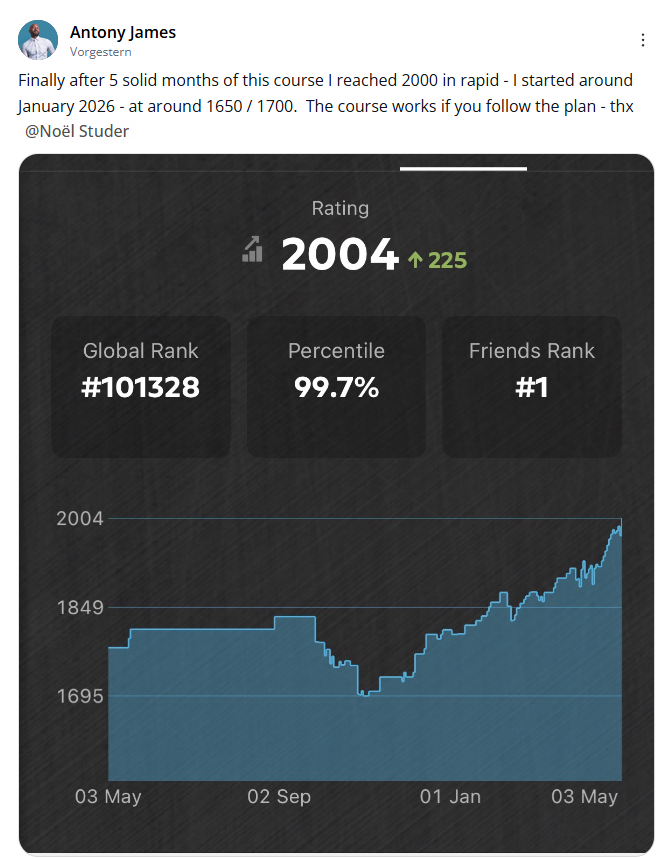
I was reminded of it once again when a SCIS student shared his success story last week. What looks like a straight graph after an initial dip, is a lot of ups and downs. And if we focus too much on results, every dip along the way could mean quitting instead of sticking to the right process.
Oh, and the business? Comparing the six months of my challenge to the same period one year earlier, I 2.9x’d my revenue. Funny how that works, isn’t it?
PS: If you haven’t tried Real Chess Training yet, you’re really missing out. It is for players between 1500-2000 chesscom Rapid / FIDE and I call it the most important 45 minutes of your chess week. You can get a free test and video explanation here.
Keep improving,
GM Noël Studer
PPS: This article was initially sent out to my Newsletter list. If you want to get chess improvement advice for free in your inbox, join 17,000+ chess improvers by signing up for Friday Grandmaster Insights here.
Whenever you’re ready, here is how I can help you:
- Want to know How to train chess well? Check out The Simplified Chess Improvement System. This course taught 800+ students the How of Chess Training. Create your high-quality chess plan and learn how to study each part of Chess, from tactics to openings & endgames. Click here to learn more.
- Rated below 1200 Chess.com? Need to refresh your fundamentals? Check out my course, Beginner Chess Mastery. You’ll learn all the fundamentals, from strategy to how to get the most out of your pieces, tactics, and endgames. You even get a full opening repertoire for free. Click here to learn more.