Scientists estimate there are 4.8 × 10⁴⁴ legal chess positions.
That is 4.8 followed by 44 zeros.
Yet the chessworld is flooded by opening courses and promises to “just watch this and get better”.
The promise that you can somehow learn all the opening moves, or never get in a position you feel unfamiliar with is equally absurd and bad for the students.
So why are we humans still drawn to this? And what is the honest solution instead?
We are drawn to simple stories
To make sense of a complex world, we humans are amazing at forming overly simplified stories.
We form stories about our past, the people we live with and the world around us.
Billionaires form stories about why they deserve to be rich.
The powerful form stories about why they deserve power.
The overly simplified story of chess is that you simply need to learn some opening theory to get better at the game.
It can either be a defense mechanism: “I’m not into learning openings, that’s why I suck” or a hope about an easy way to improvement.
Because of that need for oversimplifications, we are and will always be, prone to fall for the strong advertisements, promising easy solutions. Part of it is because believing a simple story, for a brief moment, is so much nicer than the messy truth.
The messy truth about chess
Chess is an extremely difficult game. There are more possible chess games than atoms in the universe.
You could spend your whole lifetime learning openings, memorizing positions, forming plans of pawn structures and would still get into new positions in a majority of your games.
There is no way avoiding it. And the harder you try, the more afraid you will be of new positions coming up.
Remember the two arrows from last week?
The first arrow is the fact that we all will get new positions in most games. It is painful, but you can’t avoid it.
The second arrow is only for those who try to avoid getting into new positions. Those who study openings as if it would be something to ever be done and finished. The more they do it, the more anxious, upset and scared they get.
That suffering is optional.
What works
This isn’t anything new.
Good chess teachers over the past decades have realized what works for improving chess players. Because of the many positions we can get in, a good teacher needs to improve the way their students play any position.
I’ve had the pleasure to work with world class Grandmaster coaches from Yusupov to Aagaard, RB Ramesh and Ragger. All of them tested me in positions without any hints, where I felt the same uncertainty I’ll feel in a game.
I gotta think straight.
Calculate some lines.
Use my time smartly.
Make a decision, even when I’m unsure.
Ultimately, that’s what chess is all about.
How often do you train in uncertainty?
Now take a moment and go through your last week of chess training. Ask yourself: outside of games, did I train under any uncertainty?
That means positions where you have no hint, nobody to listen to, just yourself sitting in front of a position and having to make a choice.
For most, the answer is no.
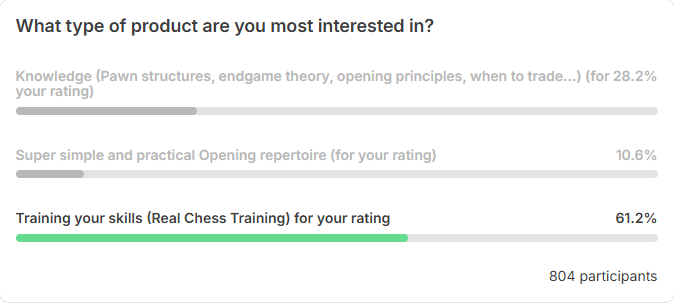
That should change. And many of you are willing to change it. Two weeks ago, 61% of the 804 readers who voted, shared that they are most interested in training their skills.
That’s exactly what training in uncertainty is for.
How to train in uncertainty
If you are between 1500-2000 chesscom/Fide or equivalent, the product already exists. It is Real Chess Training. You can join 500 improvers to get a humanly-crafted 6 position test every monday, solve it in 45 minutes, then watch the solution video.
For those already in RCT, just take this message as a motivational speech to keep going, even if it is hard. 🙂
You have the choice between monthly and yearly membership, yearly gets you 4 months free.
Check out the details here.
For those in the 1000-1500 rating range, I’m working on launching a simplified version of the current RCT for you. The same mechanism, just adapted to your level.
But attention!
Because you are so unused to this way of training, it will feel hard initially.
Over time, you’ll feel more comfortable and confident. You’ll stop fearing new positions, relax and trust your decision making, whatever gets in front of you.
That’s true confidence. Confidence that you’ll carry over to anything you do in life. The confidence you can only build through doing hard things.
Keep improving,
GM Noël
PS: This article was initially sent out to my Newsletter list. If you want to get chess improvement advice for free in your inbox, join 17,000+ chess improvers by signing up for Friday Grandmaster Insights here.
Whenever you’re ready, here is how I can help you:
- Want to know How to train chess well? Check out The Simplified Chess Improvement System. This course taught 1500+ students the How of Chess Training. Create your high-quality chess plan and learn how to study each part of Chess, from tactics to openings & endgames. Click here to learn more.
- Rated below 1200 Chess.com? Need to refresh your fundamentals? Check out my course, Beginner Chess Mastery. You’ll learn all the fundamentals, from strategy to how to get the most out of your pieces, tactics, and endgames. You even get a full opening repertoire for free. Click here to learn more.