One of the key aspects of chess playing that gets misunderstood is how to use strategy in a real game. Seeing Grandmasters and YouTubers explain so many interesting concepts can easily persuade you to try too hard to understand & apply strategic concepts.
Today I want to share a super simple rule of thumb:
If you don’t understand it yet, you won’t figure it out during a game.
A Quick Test
Let’s take this position as an example. Think for 2-3 minutes before reading on.
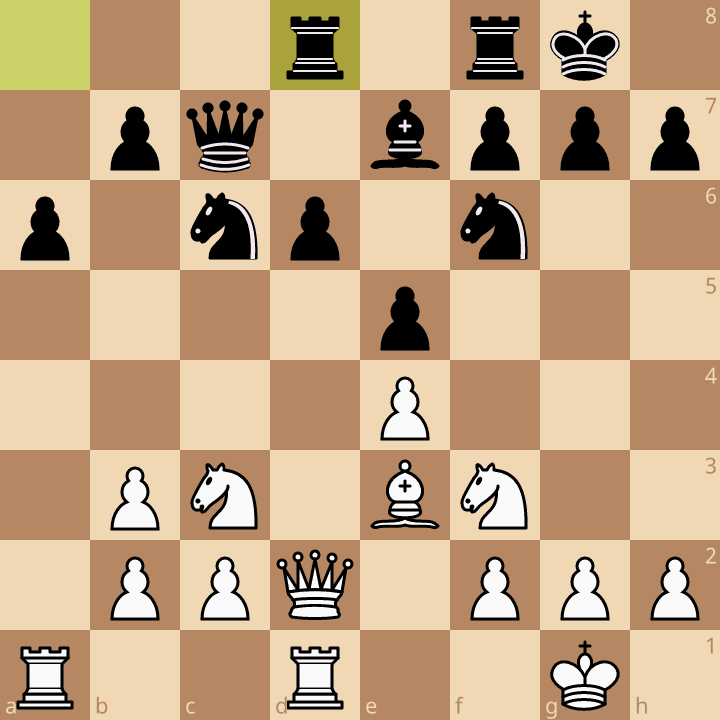
I tested this position with many students and there is a very clean split.
Those who understood the strategy before looking at this position had 1.Bg5 as a candidate move and often decided for it very quickly.
Those who did not know about the importance of the d5 square and the common trade Bg5-xf6, had many other candidate moves but Bg5 didn’t come to mind.
That didn’t change if they spent 2, 5 or even 15 minutes on this positon.
How To Waste A Lot Of Time
Here is how many go wrong.
During the game they try to figure it out. This is a nearly impossible task. It is like looking for a needle in a haystack, without knowing what the needle even looks like.
The goal during the game is to make the most out of your current chess understanding and skills. This is done by trusting your intuition, thinking about the position and a lot of concrete calculation.
You can ask yourself “What is this position about?”
And whatever comes up then is probably the best you’ll get. So you need to trust that, think concretely about a way to implement it and accept that it is the best you can do.
In some cases, this just means developing a piece because you don’t know much more about the position.
The Solution
Oh and the position: 1.Bg5 is best because the strategic goal of White is to have a Nd5 that Black can’t challenge. The best way is to have Nd5 vs Be7, with Queens and Rooks still on the board. To achieve that, we need to get rid of the Nf6, that’s why 1.Bg5 is logical.
And if you think from Black’s side, 1…Ne8!? is strategically interesting because trading off the e7 Bishop is better than letting White take on f6. Here again, if you aren’t crystal clear about the strategy of the positon, Ne8 will strike you as a noobish move and never appear as a candidate.
The line goes on with 2.Nd5, that’s where calculation is needed to apply the strategic concept in a game.
The Wrong Instinct
Reading this, you might get inspired to learn a lot of strategy so you’ll never not know what exactly to do.
Sadly, chess isn’t that easy.
Next week I’ll write about the opposite problem: why knowing too much strategy, without the skills to apply it, can hurt you just as much.
Keep improving,
GM Noël
PS: This article was initially sent out to my Newsletter list. If you want to get chess improvement advice for free in your inbox, join 17,000+ chess improvers by signing up for Friday Grandmaster Insights here.
Whenever you’re ready, here is how I can help you:
- Want to know How to train chess well? Check out The Simplified Chess Improvement System. This course taught 800+ students the How of Chess Training. Create your high-quality chess plan and learn how to study each part of Chess, from tactics to openings & endgames. Click here to learn more.
- Rated below 1200 Chess.com? Need to refresh your fundamentals? Check out my course, Beginner Chess Mastery. You’ll learn all the fundamentals, from strategy to how to get the most out of your pieces, tactics, and endgames. You even get a full opening repertoire for free. Click here to learn more.