
just played a Padel tournament. And I realized how much of an advantage I have over people who never competed professionally.
While this little tournament for me was nothing special compared to years competing professionally, for many, it is the only pressure in competitions they ever felt.
So when under pressure, once they started losing a few points and made a few mistakes, I saw the same pattern left and right:
- Either they started playing super safe, essentially serving the ball on a silver platter for their opponent.
or
- They started trying to force points, hitting shots they should never try, resulting in a lot of unforced errors.
It’s the exact same pattern I see in chess.
You lose a few games in a row. Nothing seems to go your way. You feel the pressure building up. The more you lose, the more you try to get out of this bad streak. And that’s when you make one of two possible mistakes.
- You lose self-confidence and go overly passive. You don’t even calculate concrete ways to get out of a slightly uncomfortable position. Any half-threat from your opponent seems like a #1 threat you absolutely need to stop.
- You try even harder. Attack early on. Calculate moves you have no business even looking at, because they are way above your paygrade at the moment.
Both mistakes have the same pattern in common: when things aren’t going your way, your natural tendency is to change something. If you are more of a scared person, you’ll tend to go with #1. If you like to control things and tend to be type-A, you likely fall into mistake #2.
Why This is Bad
Both ways are a mistake because you get away from what currently is your best way of playing chess.
Which always is just looking at the position at hand, and trying to figure out what is the best practical decision right now. It is extremely human to let feelings influence those decisions. However, exactly those feelings make you play worse and make it more likely you’ll lose yet another game.
The simple solution, which is so hard to implement for anyone under pressure, is to focus on playing your best and forget about whatever has happened before. That means playing the same way no matter if you lost or won 5 games in a row, and also no matter if you had a totally winning or losing position in this particular game before.
Any big changes you try to make should happen in training, not on the fly during the game because things aren’t going your way.
The best we can do
I played professionally for 6 years, and many more semi-professionally. I’ve worked with amazing coaches, and for over 6 years with a sport psychologist. I can confidently say it was impossible for me to never get influenced by any emotions. That would make me a robot, and in my opinion, is a very utopian goal.
What I managed to do instead is to learn from every instance where emotions negatively influenced my decision making, and to become more aware of it happening. Realizing during a game that you try to push for an impossible attack is already a huge win.
What I also learnt is that the more situations I experienced under pressure, the more resilient I got. Scoring 1/9 in my most important tournament to that point, Biel 2017, was heartbreaking.
After a decent start with a fighting loss against Peter Leko, and two draws against Hou Yifan and David Navara, I lost 6 games in a row.
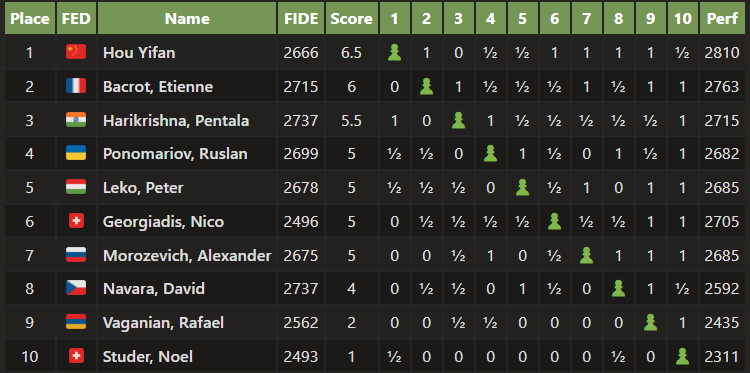
With every loss I got more upset, insecure and tried to force a result harder.
Instead of focusing on my strengths and the basics, I tried to go all out to “change things.”
Experiences like that made me so much stronger. I realized I can’t force results. And when bad tournaments happened, I looked back to Biel 2017 and thought: it won’t be worse than that!
We can’t avoid those hard moments. We can only learn from them.
It (very slowly) becomes second nature
Back at the Padel tournament, while others went passive or started forcing it, I caught myself continuously saying:
Just focus on the basics. Stay calm. Enjoy. Always keep fighting.
Does that mean I played perfectly and won?
Hell no. Not even close. But at least I felt like I played my best possible game, even when under pressure. That’s all I can do in the moment.
I hope you’ll remember this next time things aren’t going your way. The best you can do is to stay calm, try your best, and avoid going passive or trying too hard. And no matter what, remember to enjoy your hobby.
Keep improving,
GM Noël Studer
PS: This article was initially sent out to my Newsletter list. If you want to get chess improvement advice for free in your inbox, join 18,000+ chess improvers by signing up for Friday Grandmaster Insights here.
Whenever you’re ready, here is how I can help you:
- Want to know How to train chess well? Check out The Simplified Chess Improvement System. This course taught 1400+ students the How of Chess Training. Create your high-quality chess plan and learn how to study each part of Chess, from tactics to openings & endgames. Click here to learn more.
- Rated below 1200 chesscom? Need to refresh your fundamentals? Check out my course, Beginner Chess Mastery. You’ll learn all the fundamentals, from strategy to how to get the most out of your pieces, tactics, and endgames. You even get a full opening repertoire for free. Click here to learn more.
- Rated between 1500-2000 chesscom Rapid? Ready for a hard challenge every single week? Check out Real Chess Training, my membership with weekly 6 position tests. Train your skills under game-like conditions.


